

The Strength Deployment Inventory (SDI) is an assessment of human motives and strengths. It stands on the foundation of practical application, scholarship, and research that began with Elias Porter’s introduction of the SDI in 1971 and publication of Relationship Awareness Theory (Porter, 1976).
Today the SDI offers four views of a person: a Motivational Value System, a Conflict Sequence, a Strengths Portrait, and an Overdone Strengths Portrait. These four views form a systems view of personality and productiveness at work. When personality is considered in the context of relationships, and viewed as a dynamic system, greater explanatory power is available than when personality is viewed as independent variables or dichotomies (Lewin, 1935; Piers, 2000; Sullivan, 1953).
Figure 1:
Relationship Intelligence Model
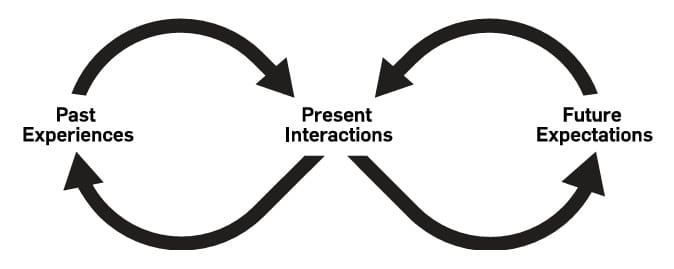
The purpose of the SDI is to improve the quality of working relationships. People have relationships within themselves, with each other, and with their work. Relationships are psychological connections over time; they have history, the present moment, and expectations for the future (Figure 1). Improving relationships requires beginning with self-awareness. Increased self-awareness results from greater conscious understanding of the true self, and the reduction or removal of defenses against self-understanding. Greater self-awareness enables more clear and accurate understanding of others.
Relationship intelligence is the application of knowledge in specific settings or contexts to produce results that are meaningful to people in relationships.
Relationship intelligence helps people to:
> > better understand past interactions, enabling a deeper understanding and appreciation of self and others.
> > manage choices and perceptions in the present moment, enabling more effective behavior and communication in relationships.
> > anticipate the thoughts, feelings, and actions of others, giving them greater control over the future outcomes of their relationships.
These skills are essential to creating collaborative communities that foster learning, development, and authentic connections to others and to work.
MOTIVES
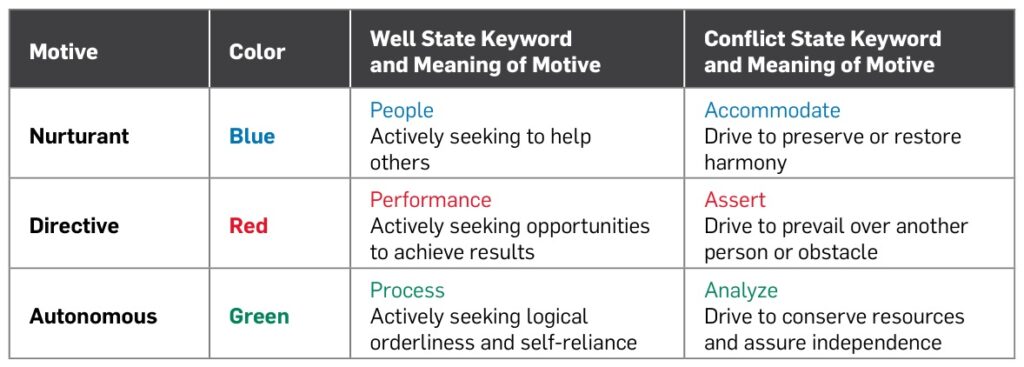
Motives are the primary determinants of personality types described by SDI results. There are three primary motives, which are experienced differently in two emotional states: 1) when things are going well and 2) when there is conflict. Motives are purposive in nature; they are the underlying drives or reasons that energize a person to think, feel, or act in various ways as they relate to others.
Motives in Two Conditions
STRENGTHS
The SDI presents a prioritized set of 28 strengths to each respondent. Strengths are behaviors that are driven by underlying motives and productive intentions. Strengths are generally valued and appreciated in the context of relationships. The 28 strengths (and their overdone counterparts) in the SDI should be viewed as part of an overall personality theory.
Strengths may also be viewed as traits. Each strength has a connection with motives and personality type. But strengths, because they are behaviors, are freely chosen by people as they consider their situations, goals, and relationships. Desires and beliefs help to explain action and give it meaning (Rosenberg, 2008). The application of strengths is variable across situations. There are correlations with personality, but strengths alone are not the essence of personality. Instead, strengths are the ways that individuals express their core motives through action.
TESTIMONIAL
“The implementation of the (Core Strength) training has been transformational to our organization. it provides our workforce with the tools they need to be better leaders, better teammates, strengthen relationships and get better results.”
SHERYL D. ROY
GLOBAL ORGANIZATIONAL EFFECTIVENESS CONSULTANT, EXXONMOBIL
DOWNLOAD: LISTENING – How to Listen to Different Types of People
Explore, discuss, experience Crucial Learning’s Strength Deployment Inventory (SDI) and Trainings!
Send us a message to inquire or email us at [email protected].