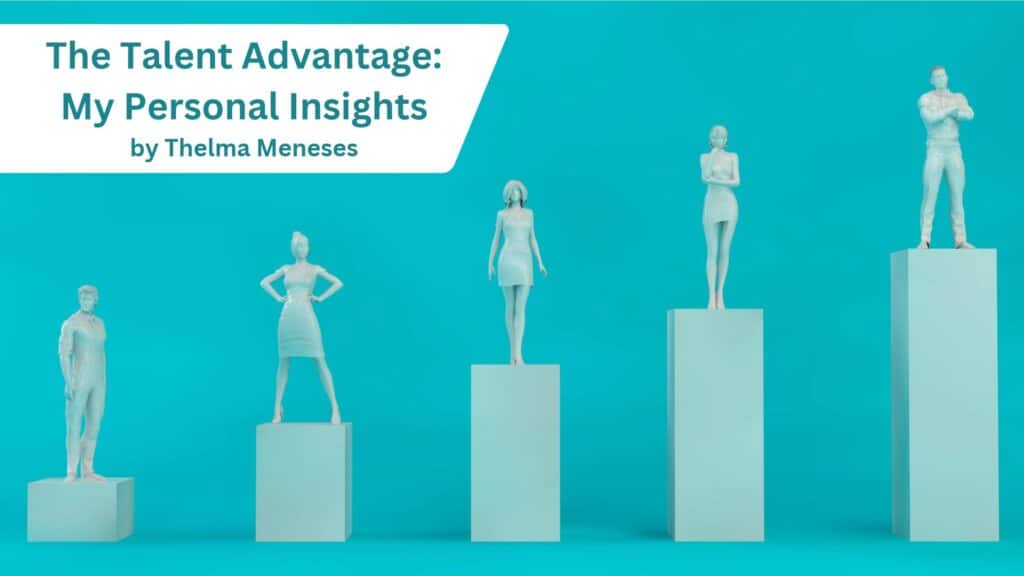
Why the best competitive edge in a fast-moving organization is not capital, technology, or even strategy — but the deliberate architecture that lets great talent become its best version.
The Premise
Organizations that scale at blistering pace often arrive at a paradox: the faster they grow, the more their people systems lag behind their business ambition. Headcount multiplies, geographies spread, and the informal culture that once made the company magnetic begins to fray. The companies that sustain momentum are not the ones that hire the loudest — they are the ones that build deliberate systems for Organization Development (OD), Performance Management (PMS), and Culture that reinforce one another.
For organizations operating in complex, high-stakes environments — SPARC Real Estate Property, with its real estate asset-heavy, customer-facing, relationship-driven operating model, and Rhenus Logistics Philippines Inc, operating across borders in a network-dependent, time-critical global supply chain — the stakes of getting this right are unusually high. Both industries punish misalignment: a property development is a multi-year bet on human capability, and a logistics network is a real-time test of coordination, trust, and judgment under pressure.
How are the three-legged stools — OD, PMS, and Culture — converge to create sustainable growth, unlock the best version of a diverse talent pool, and build the kind of disruptive innovation that only happens when people feel safe enough to speak up.
1. Organization Development: Designing the Container for Growth
OD is often reduced to change-management workshops. For the two companies I have worked with, they looked at OD as something more fundamental: the intentional design of structure, roles, processes, and capability so that the organization can execute today while adapting for tomorrow.
Alignment as the first act. OD begins by asking whether the organization’s structure matches its strategy. In a property business, it meant separating disciplined capital allocation and project delivery from a more entrepreneurial, customer-experience-oriented front end. In Rhenus, it meant designing for both standardization (so service levels hold across geographies) and local autonomy (so operations leaders can respond to volatile conditions). When structure follows strategy, the friction that silently drains talent energy disappears.
Capability as an asset class. Sustainable growth requires viewing capability — not just individual skills, but organizational muscle — as a portfolio to be built deliberately. That means identifying the capabilities the business will need in three years, not just the competencies it needs this quarter, and investing in them before they’re urgently required.
Change as a continuous discipline. OD that treats transformation as a one-time event fails. For these two companies, the OD function becomes a permanent capability for sensing misalignment and correcting course — a nervous system for the organization, not just a project team.
2. Performance Management: From Judgment to Development
Too many performance systems are built to rank and reward, and only accidentally to develop. The organizations that convert talent into competitive advantage use PMS as a growth engine — a system that clarifies expectations, surfaces honest feedback, and builds capability continuously.
Clear, connected goals. Performance begins with line of sight. When an individual can draw a straight line from their daily work to the organization’s strategic priorities — and when those priorities are visible and updated as conditions shift — engagement rises and wasted effort falls. In project-driven property work and network-driven logistics alike, cascading goals must be living documents, not annual artifacts.
Feedback as a habit, not an event. Annual review cycles are increasingly inadequate for organizations moving at speed. The shift is toward frequent, low-friction conversations — check-ins, coaching moments, in-the-flow feedback — that turn performance management into an ongoing dialogue. This is what allows diverse talent to develop where they are, in real time, rather than waiting for a formal verdict.
Development over judgment. When PMS is experienced as a development tool rather than a grading exercise, people become willing to take the risks that innovation requires. The system signals: we are investing in your growth, not just measuring your output. For a diverse talent pool, this distinction is decisive — it determines whether difference is treated as a deficit to be corrected or as an asset to be cultivated.
Fairness and transparency. Diverse, distributed workforces are especially sensitive to perceived arbitrariness. Transparent criteria, consistent calibration, and clear pathways create the trust that lets people commit fully.
3. Culture: The Operating System Beneath Everything
Culture is not a poster. It is the sum of what an organization repeatedly rewards, tolerates, and punishes. In organizations scaling at pace, culture is the difference between a group of talented individuals and a coherent, high-performing collective.
Psychological safety as the foundation of innovation. The reason so many organizations fail to innovate despite hiring brilliant people is that speaking up carries risk. Disruptive ideas rarely arrive fully formed — they arrive as tentative, half-formed observations from people closest to the problem. Building a culture where people can challenge, question, and propose — without fear — is the precondition for disruption.
Diversity as a source of edge, not a compliance metric. Diversity delivers competitive advantage only when it is matched with inclusion and genuine voice. The best version of a diverse talent pool emerges when difference is actively sought in decision-making . Homogeneous teams may feel smoother, but they plateau; cognitively diverse teams, well-led, generate the friction that produces better decisions.Values that are lived and enforced. Culture is credible only when values drive real decisions — who is promoted, what behavior is protected, what is refused even when it is profitable. Leaders who tolerate brilliant jerks or punish truth-tellers teach the organization which values are real.
4. The Convergence: Where Growth Becomes Sustainable
The real power emerges when OD, PMS, and Culture operate as one system rather than three disconnected programs.
- OD creates the structures and capabilities that let talent and strategy align.
- PMS creates the rhythms of clarity, feedback, and development that let talent grow and contribute.
- Culture creates the safety and inclusion that let diverse talent speak up and innovate.
When these reinforce one another, the organization gains a compounding advantage: people who feel developed stay and deepen; people who feel heard innovate; people who innovate create the disruption that outpaces competitors. Growth becomes sustainable not because it is slowed, but because it is self-reinforcing — momentum is generated from within, by engaged people, rather than purchased through constant external churn. In a blistering-pace environment, this is precisely the asset that cannot be copied. Competitors can replicate a product, a pricing strategy, or a capital structure. They cannot easily replicate an organization where thousands of people feel genuinely involved in progress.
5. Why Great Talent Remains the Decisive Competitive Edge
In an era of abundant capital and accelerating technological parity, the marginal advantage increasingly comes from people — specifically, from the quality of their engagement and the freedom of their contribution. Talent is not simply headcount; it is judgment, initiative, and discretionary effort.
Organizations that build the OD-PMS-Culture architecture described here create a durable competitive moat: they attract ambitious talent, develop it deliberately, include it genuinely, and release it to innovate. They convert diversity from a statistic into a strategic weapon and turn high pace from a source of burnout into a source of momentum.
6. The Leader’s Work: The Power of Shared Leadership
The final, and perhaps hardest, shift is the leader’s own. The reflection leaders must undertake is uncomfortable: Do my behaviors create the conditions I claim to value?
Shared leadership is not delegation. It is the deliberate distribution of ownership and voice across the organization — the recognition that in complex, fast-moving environments, no single leader has sufficient perspective to think alone. Leaders who lead through shared leadership build more decisions, faster, and with greater ownership.
Reflection as a leadership discipline. Leaders who build learning organizations must themselves learn in public: asking better questions, seeking dissenting views, admitting what they don’t know, and treating every team as a source of intelligence. This modeling is how psychological safety becomes believable rather than aspirational.
Learning from the organization. The most valuable reflection is not inward but outward — listening to the people closest to the work, the customers, and the front line. Shared leadership requires leaders who treat the organization as a learning partner rather than an instrument of their vision.
Conclusion
OD, PMS, and Culture are not separate initiatives. They are three expressions of a single commitment: that an organization’s greatest competitive edge is its people, and that people perform at their best when they are structured to succeed, developed and heard, and safe to be fully themselves.
For organizations scaling with ambition — in property, in logistics, in any industry where pace and complexity are constants — the lesson is consistent. Sustainable growth, disruptive innovation, and the full power of diverse talent are not things that happen to an organization. They are things an organization designs, through systems that reinforce one another and leaders who model shared ownership. The organizations that do this well do not merely keep pace with progress — they create it.
I am deeply honored and humbled to be a part of these two great companies- one local and one international. They operate in different business landscapes. However,they have on thing in common – EXTRAORDINATY LEADERS WHO PROVIDE EXCELLENT PRODUCTS AND SERVICES, DEVELOP GREAT TALENT AND POSSESSES TREMENDOUS UNDERSTANDING OF THEIR CUSTOMERS.